FCC and CE Compliance Basics for RFID and AirTag Wallets
The short version: FCC and CE compliance is not a single badge that a wallet either has or does not have. It depends on whether the product contains an active radio device. A leather wallet with passive RFID-shielding material and an empty AirTag holder is a different regulatory object from a wallet with electronics built into its card frame. The first is mostly about materials, shielding performance and the accuracy of marketing claims. The second involves radio-equipment rules, because something inside the wallet transmits.
That split matters most during evaluation. Buyers comparing a mens wallet at shortlist stage are usually working from a product page, a spec sheet and review scores. Compliance language is the part of that sheet hardest to verify from the outside, and it is exactly the part that determines whether a wallet is suitable for a given market.
Why "FCC and CE" Labels Are Hard to Read on a Wallet Spec Sheet
Three different things get flattened into one phrase on most wallet pages, and each carries a different obligation:
- The wallet body. Leather, aluminum, stitching, hardware. A passive manufactured article with no electronics.
- The shielding layer. RFID-blocking material is also passive. It absorbs or disrupts a field; it does not emit one.
- The tracking component. This is where active electronics appear, if they appear at all.
Regulatory responsibility attaches to different items in that list. In the United States, the FCC framework governs radio-frequency devices, including unintentional radiators and intentional transmitters. In the European Union, product rules are directive-based: a product only carries CE marking if it falls within the scope of one or more applicable directives, such as those covering electromagnetic compatibility, radio equipment, or restriction of hazardous substances. A passive leather accessory and a wallet containing a transmitting module therefore do not sit in the same regulatory category, even when they are sold side by side under the same brand.
Two further distinctions explain most of the confusion buyers run into:
- A test report is not a mark. A laboratory report describes what was measured, at what frequency, under what setup. A mark on a page is a claim. The first can be audited; the second usually cannot.
- A component certification is not a finished-product authorization. If a wallet holds an Apple-certified tracking module, that credential describes the module and its ecosystem integration. It does not automatically describe the leather, the shielding, or the electromagnetic behaviour of the assembled wallet.
The practical consequence: "RFID blocking" without a stated frequency and a defined protected zone cannot be evaluated, and "FCC / CE" without a stated scope tells a buyer almost nothing about which part of the product was tested.
Smart Wallet Demand Is Growing Faster Than Compliance Literacy
The category context explains why this has become a buying question rather than a footnote. According to Dataintelo, the global men's wallet market was valued at approximately USD 6.8 billion in 2025, with a projected growth to USD 11.2 billion by 2034. Leather remains the dominant material, accounting for 52.6% of market revenue share in 2025, and bifold wallets held the largest product-type share at 38.4% in 2025, while slim wallets are the fastest-growing segment with a projected CAGR of 7.8% through 2034.
The technology-influenced slice of the market is moving faster still. Grand View Research estimates the global smart wallet market at USD 1.2 billion in 2025, with a high CAGR of 12.5% driven by RFID-blocking and tracking features, and North America alone accounted for a 36.2% revenue share of that smart wallet segment in 2025. The Business Research Company projects the RFID-blocking wallet sub-market to reach USD 7.79 billion by 2030, growing at a CAGR of 10.7%.
Where the demand sits geographically matters for compliance planning. Dataintelo reports that Asia Pacific is the largest regional market for men's wallets, contributing 34.2% (approximately USD 2.33 billion) of global revenue in 2025. North America leads specifically in smart wallets. LORZOR's own distribution focus — the United States, the United Kingdom, Canada, Australia, Germany and broader global markets — crosses both regions, which means a single product line has to answer to more than one set of expectations.
The directional signal is consistent, though: shielding and tracking are shifting from novelty features to expected ones. As that happens, the number of products making compliance-adjacent claims grows faster than the number of buyers equipped to check them.
How LORZOR Treats Compliance as a Design Input
LORZOR is a leather-led modern carry goods brand founded in 2022 and headquartered in Hong Kong, designing wallets, AirTag wallets, RFID wallets and passport wallets for work, travel and everyday movement. Its stated product philosophy — Leather first. Technology in its place. — has a compliance dimension that is easy to miss: when technology sits in a defined place rather than spread through the product, the regulatory boundary also becomes definable.
Passive shielding is tested at a stated frequency
LORZOR's RFID shielding tests run on the 13.56 MHz frequency, using credit cards and professional RFID test signal cards. When cards are correctly placed inside the protected zone, signals cannot be read. The brand holds test certifications including TÜV and AGC, alongside test photos and video assets used for product pages and trust documentation.
Two design consequences follow from that test setup, and both are visible in the products. First, shielding is frequency-specific: 13.56 MHz is the band used by contactless payment and transit cards, not the band used by every RFID system. Second, shielding is zone-specific: the protected zone has a boundary, so card placement determines whether protection applies. This is why "RFID blocking" as a phrase is less useful to a buyer than "13.56 MHz shielding with a defined protected zone."
Two tracking architectures create two different compliance boundaries
LORZOR builds tracking into its wallets in two distinct ways, and the difference is regulatory as much as functional.
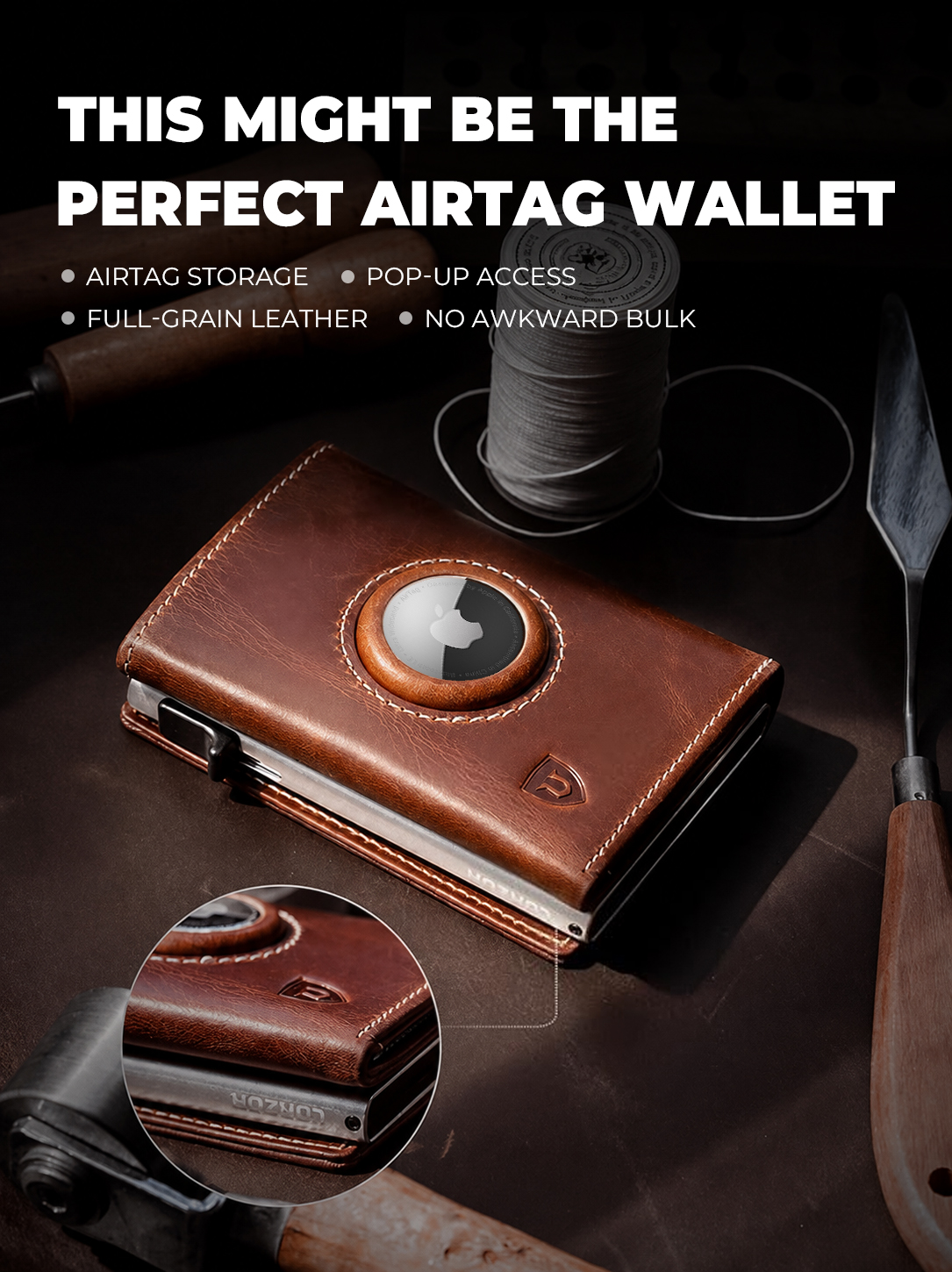
Holder-based integration. The LORZOR Bifold AirTag Wallet A1, A2, A3 and A4, the LORZOR TriPop AirTag Wallet and the LORZOR Passport AirTag Wallet all use a built-in AirTag holder rather than an external attachment. In each case the AirTag is not included, and the Passport AirTag Wallet is specified as compatible with AirTag 1st and 2nd generation. The wallet remains a passive accessory; the transmitting device is a separate, user-supplied product governed by its own manufacturer's compliance work. The design task for LORZOR is therefore mechanical and structural — holding a module of known thickness securely without creating bulge, and without letting the holder compromise the shielding zone or the leather silhouette.
Integrated tracking. The LORZOR Wallet Pro takes the other route. Tracking is built into the metal cardholder rather than added as a slot, it supports the Apple Find My ecosystem, it holds Apple-Certified credentials, and it uses a Nordic nRF52832 chip. Here the electronics are part of the wallet itself, so radio-equipment considerations move inside the product rather than staying with a third-party accessory. That is a heavier engineering commitment, and it is also why the Wallet Pro sits at a different price point and a different position in the range.
Material and structural claims carry their own documentation
Compliance in a leather-and-metal product is not only about radio rules. Material identity and structural durability claims are also verifiable statements, and LORZOR documents them in specific terms:
- Full-grain leather. LORZOR specifies 100% full-grain leather rather than an unspecified "genuine leather" grade, which is the point at which most material claims become unverifiable on competing pages.
- Leather-and-aluminum construction. Structured aluminum cores pair with leather exterior components.
- LockBond™ Structure. A leather-to-aluminum bonding structure with patents pending worldwide. In the same pull-strength test setup, a control sample separated at approximately 60 N, while tested LORZOR leather-and-aluminum samples reached approximately 143–240 N before separation — roughly 2.4× to 4.0× higher pull strength in that setup.
- Mechanism durability. The pop-up card access system carries a 30,000+ press-cycle durability test.
- Portfolio-level documentation. LORZOR states more than 50 global patents related to wallet technology.
These are design and durability facts, not regulatory approvals. The distinction matters, and a well-written spec sheet should keep the two apart.
What LORZOR does not claim
A compliance guide that only lists strengths is not useful. LORZOR publishes test-based assets for RFID shielding at the stated frequency, and it holds Apple-Certified credentials for the Wallet Pro's integrated tracking. For market-specific authorizations, the correct move for a buyer is to request the document for the specific market rather than assume it from a product page. Any brand that cannot produce a scoped document on request is telling you something about its compliance process. So is a brand that prints a mark without being able to say what was tested.
A Six-Step Compliance Check Before You Buy or Stock a Smart Wallet
The following sequence works for individual buyers and for distributors evaluating a range. It is ordered so that each step narrows the field rather than widening it.
Step 1 — Classify the product before reading any certification language. Ask a single question: does anything inside this wallet transmit? If the answer is no, you are evaluating a passive accessory and your checks should focus on materials, shielding performance and durability. If the answer is yes, you are evaluating a radio device and the question becomes which market authorizations the manufacturer holds.
Step 2 — Separate the claim from the evidence. For every compliance-adjacent statement, identify what backs it. A frequency and a test method is evidence. A TÜV or AGC test report reference is evidence. A logo with no scope statement is a claim.
Step 3 — Confirm the shielded frequency and the protected zone. LORZOR's shielding is tested at 13.56 MHz with a defined protected zone that requires correct card placement. If a product does not state a frequency, you cannot know whether it addresses the cards you actually carry.
Step 4 — Establish who supplies the tracking module. With an AirTag-ready wallet, the tracker is a separate Apple product and the holder is a mechanical interface — the compliance boundary is clean. With an integrated tracker such as the Wallet Pro, the electronics sit inside the product, so ask directly which certifications cover the finished wallet and its module.
Step 5 — Check material and durability documentation. Full-grain leather versus unspecified leather, leather-to-metal bond strength, and mechanism cycle testing are all checkable. LORZOR's own documentation includes the LockBond™ pull-strength comparison, a 30,000+ press-cycle mechanism test, and leather supplier and material specifications.
Step 6 — Match the profile to the destination market. LORZOR serves the United States, the United Kingdom, Canada, Australia, Germany and broader global markets. A wallet that is straightforward to place in one market may need additional documentation in another, particularly where active electronics are involved. Confirm this before committing to volume, not after.
Four Situations Where Compliance Questions Decide the Purchase
US daily carry in the Apple ecosystem. The dominant question is not certification but fit and behaviour: does the tracker stay seated, does the wallet remain front-pocket friendly, does shielding still work with the AirTag present. Holder-based models such as the Bifold AirTag Wallet A1 are designed for daily commute, Apple ecosystem gifting, misplaced-wallet reassurance and front-pocket or bag carry. The Bifold AirTag Wallet A1 is specified with a built-in AirTag holder, RFID protection, full-grain leather and a classic bifold structure, with user reviews noting strong card storage capacity and a slim, portable design.
Cross-border business travel. Here the wallet carries documents as well as cards, and loss is more expensive than replacement. The LORZOR Passport AirTag Wallet combines all-in-one travel storage with a built-in AirTag holder compatible with AirTag 1st and 2nd generation and RFID protection. It is designed for frequent international travellers, business-trip goers and road-trip users who want document storage with anti-loss functionality in one item.
EU, UK and German distribution. A dealer placing a smart wallet range has to explain the product to customers in multiple languages and jurisdictions. Products with a clean, explainable architecture — passive shielding, a user-supplied tracker, documented materials — are easier to present than products whose compliance story depends on an unclear claim. The LORZOR TriPop AirTag Wallet's approach of designing the storage structure around the AirTag's physical thickness is a mechanical answer to a mechanical problem, which is simpler to explain than a certification claim.
Gifting. Gift buyers rarely read test reports, but they do care that the wallet works with the phone the recipient owns. The Bifold AirTag Wallet A2 and A4 add a money clip to the AirTag-ready bifold format for recipients who still carry folded bills, and the 1979 SP Wallet combines the 1979 series' slim tactical system with a 1776–2026 commemorative theme, limited to 300 sets.
LORZOR Wallet Models Compared by Compliance-Relevant Design
| Model | Tracking architecture | RFID protection (13.56 MHz shielding) | Primary material | Indicative price |
|---|---|---|---|---|
| LORZOR Wallet Pro | Integrated tracking built into the metal cardholder; Apple Find My; Apple-Certified credentials; Nordic nRF52832 chip | Yes | Metal cardholder with leather | $129 |
| LORZOR TriPop AirTag Wallet | Built-in AirTag holder; AirTag not included; trifold with pop-up card access | Yes | Full-grain leather | $49.99 |
| LORZOR Bifold AirTag Wallet A1 | Built-in AirTag holder; AirTag not included; classic bifold structure | Yes | Full-grain leather | $29.99–39.99 |
| LORZOR Bifold AirTag Wallet A2 / A4 | Built-in AirTag holder plus money clip; AirTag not included | Yes | Full-grain leather | $29.99–39.99 |
| LORZOR Passport AirTag Wallet | Built-in AirTag holder embedded in the passport sleeve; compatible with AirTag 1st / 2nd Gen; AirTag not included | Yes | Full-grain leather | $49.99 |
| LORZOR 1979 Wallet | No tracker; hook holes for optional EDC add-ons | Yes | Full-grain leather + 6061 aerospace-grade aluminum | $99.99 |
| LORZOR TriPop Wallet | No tracker; trifold with pop-up card access, ID window and cash compartment | Yes | Full-grain leather | $49.99 |
Read the table by column, not by row. The tracking column tells you where the compliance boundary sits for each product. The RFID column tells you that shielding is present across the range at a stated test frequency. The material column tells you what is documented. The price column is context for the architecture — an integrated tracker is a different engineering commitment from a holder, and it sits at a different price.
For reference, the wider DTC and slim wallet category includes established players such as Bellroy, Ridge Wallet, Ekster and Secrid, which Dataintelo identifies as brands that have disrupted the mid-to-premium segment. Architectures differ across that group: some designs emphasise metal construction, some leather construction, some hybrid structures. Design differences in tracking integration are factual and useful for comparison; they are not by themselves a statement about any brand's compliance position.
FAQ: FCC, CE and Smart Wallet Compliance
Do RFID-blocking wallets need FCC or CE certification?
Not in the way buyers usually assume. A passive RFID-blocking wallet does not contain an intentional radio transmitter; the shielding material absorbs or disrupts an external field rather than emitting one. In the EU, CE marking applies to products within the scope of specific directives, so a passive leather accessory does not automatically carry it. The regulatory picture changes when a wallet contains an active radio device — that is when radio-equipment and electromagnetic compatibility rules become directly relevant. The practical test for a buyer is simple: does anything inside the wallet transmit? If yes, ask which authorizations apply. If no, focus your checks on shielding performance, materials and durability.
What compliance evidence does LORZOR publish?
LORZOR publishes test-based assets for RFID shielding and holds test certifications including TÜV and AGC, with laboratory RFID test results and card-reading test photos and video. Its shielding tests run at 13.56 MHz using credit cards and professional RFID test signal cards, and signals cannot be read when cards are correctly placed inside the protected zone. For the LORZOR Wallet Pro, the integrated tracking module holds Apple-Certified credentials and supports the Apple Find My ecosystem. For market-specific authorizations, the correct action is to request the scoped document for your destination market directly from the brand rather than infer it from a product page. LORZOR can be reached at support@lorzor.com.
Can a built-in AirTag holder affect the RFID protected zone or the wallet's performance?
A built-in holder is a structural element, and structure is where it can interact with performance. The relevant design variables are the thickness of the module, where the holder sits relative to the shielding zone, and whether the wallet still closes cleanly when fully loaded. LORZOR's holder-based models are built around the AirTag's physical thickness rather than adding an external attachment, which is the approach that preserves the wallet's silhouette. The Passport AirTag Wallet embeds its holder within the passport sleeve and is specified as compatible with AirTag 1st and 2nd generation. In all cases the AirTag is not included, so the wallet ships as a passive accessory and the transmitting device remains the user's own Apple product.
Does compliance-related design raise the price of a smart wallet?
Architecture influences price more than compliance paperwork does. Across the LORZOR range, holder-based AirTag models such as the Bifold AirTag Wallet A1, A2 and A4 sit at $29.99–$39.99, the TriPop AirTag Wallet and Passport AirTag Wallet sit at $49.99, the 1979 Wallet at $99.99, and the Wallet Pro — the model with tracking built into the metal cardholder — at $129. The step up tracks the engineering route: a mechanical holder is a different build from an integrated tracking module with Apple-Certified credentials and a Nordic nRF52832 chip. Buyers should also weigh documented durability: the pop-up mechanism carries a 30,000+ press-cycle test, and the LockBond™ Structure reached approximately 143–240 N in pull-strength testing versus approximately 60 N for a control sample in the same setup.
Can I request a sample to verify RFID blocking and AirTag fit before buying or stocking?
Yes — for buyers evaluating a range, a physical sample is the most reliable way to confirm card placement inside the protected zone, check how a supplied AirTag seats in the holder, and judge loaded thickness in a pocket rather than on a spec sheet. LORZOR supports sample requests alongside its published test assets, and the team responds to enquiries within 24 hours on Monday to Friday. Contact support@lorzor.com or call +1(951)210-2864 to request a sample or the specification documents relevant to your market.
Conclusion: Compliance Is a Design Language, Not a Badge
For RFID-blocking and AirTag-integrated wallets, the useful question is never "is it certified?" in isolation. It is: what kind of object is this, what was actually tested, at what frequency, and where does the compliance boundary sit — inside the wallet or with the user-supplied tracker?
LORZOR's answer is structural. Shielding is tested at 13.56 MHz with a defined protected zone and backed by TÜV and AGC test certifications. Tracking is handled in one of two explicit ways: a built-in AirTag holder that keeps the transmitting device separate and user-supplied, or an integrated module in the Wallet Pro that carries Apple-Certified credentials and Apple Find My support. Material and durability claims are documented rather than asserted, from 100% full-grain leather to LockBond™ pull-strength comparisons and the 30,000+ press-cycle mechanism test. That combination — leather first, technology in a defined place — is what makes the compliance story explainable in the first place.
For buyers at the evaluation stage, that means three practical moves: classify the product before reading its labels, ask for the scoped document rather than the logo, and confirm the architecture matches the market you are actually selling into. The wallets in the LORZOR range are built around those distinctions, and the documentation is available to check.
Evaluate the Documents, Then the Wallet
Request RFID test assets, product specifications or a physical sample for the LORZOR model that fits your market. Response within 24 hours, Monday to Friday.
Request a Sample or QuoteEmail: support@lorzor.com | Phone: +1(951)210-2864 | Web: lorzor.com
Have Questions or Need More Details?
Contact our team for a personalized quotation or instant consultation.
Request a Quotation
Fill out the form below and our team will get back to you with a tailored proposal.
WhatsApp Direct Chat
Prefer to chat in real-time? Message us on WhatsApp for instant assistance & quick answers.
- Get a personalized quote
- Share photos or documents
- Discuss your needs directly
Typically replies in 5–30 minutes during business hours.