Cross-Border Business Travel Carry: A LORZOR Passport AirTag + Bifold AirTag Application Guide
Cross-border business travel is rarely a wallet problem in the abstract. It is a sequencing problem. Passport, boarding pass, hotel key card, transit card, foreign cash, receipts and several payment cards all have to be reachable at different moments of the same day, usually while you are standing up and someone is waiting behind you.
The workable answer for most frequent travelers is not one larger wallet. It is a two-wallet system: a document wallet that stays closed until documents are genuinely needed, and a small daily wallet that handles cards and cash for every other moment. This guide applies that system to the LORZOR range — the LORZOR Passport AirTag Wallet for documents, the LORZOR Bifold AirTag Wallet (A1, A2 or A4) or LORZOR TriPop AirTag Wallet for daily cards and cash, and the LORZOR Wallet Pro or LORZOR 1979 SP Wallet as slim front-pocket options.
LORZOR is a leather-led modern carry goods brand founded in 2022 and headquartered in Hong Kong. Its portfolio covers wallets, AirTag wallets, RFID wallets, passport wallets and travel carry accessories, built around full-grain leather, slim construction and discreet technology rather than gadget-first design.
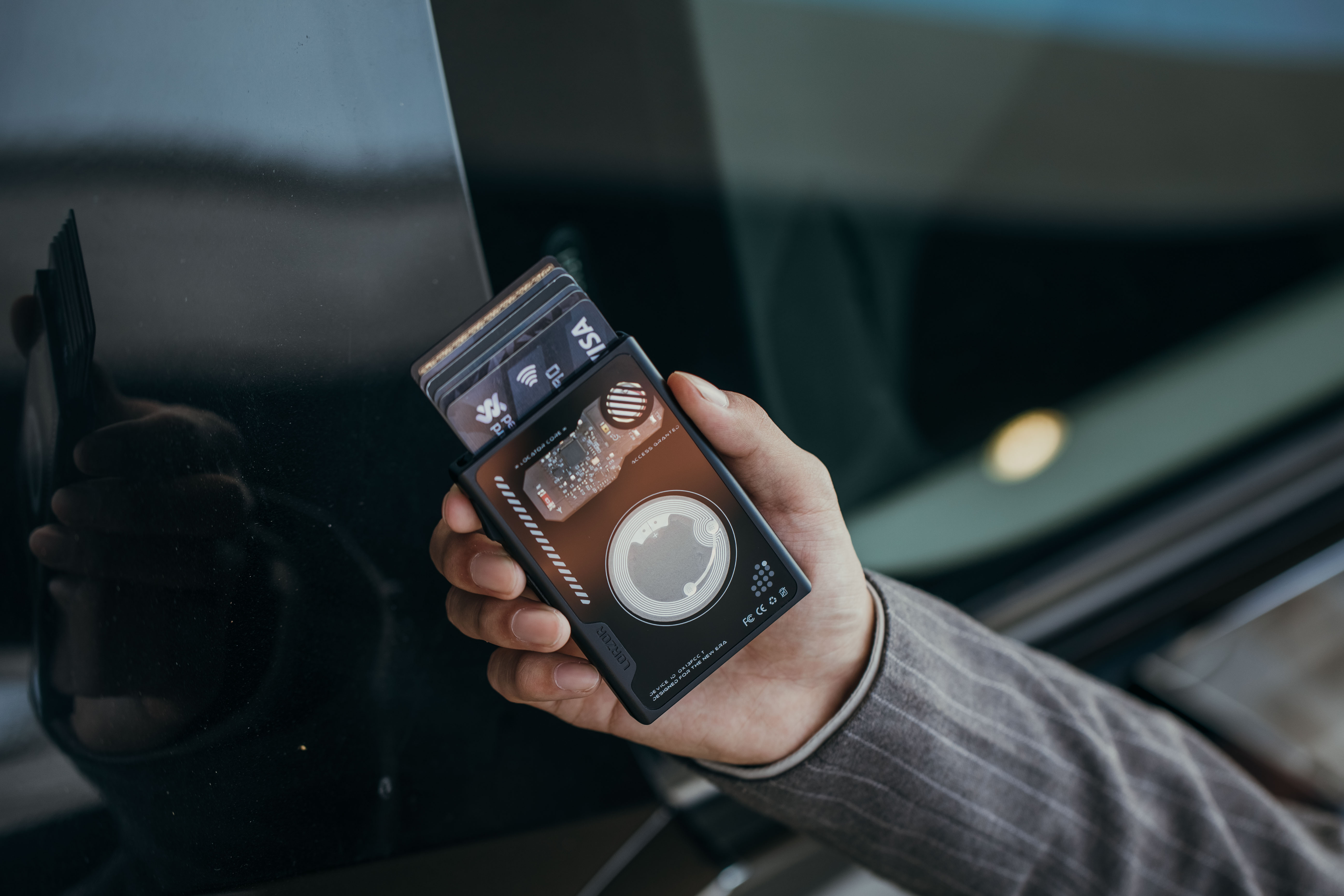
Problem Definition: Why One Wallet Stops Working on a Cross-Border Trip
Single-wallet logic assumes you mostly need one thing at a time. A cross-border travel day does not work that way. Each stage of the day pulls a different bundle out of the same pocket:
- Airport transit and security: passport, boarding pass or transit card, plus one payment card.
- Hotel desk: passport, payment card, room key, a receipt that has to survive the trip.
- Rental car counter or road leg: driving licence, payment card, cash for parking or tolls.
- Client meeting or counter payment: one or two cards, and nothing else.
When all of those items live in one wallet, the wallet is opened far more often than on a normal commute, and every opening is a chance for something to be misfiled. The predictable failure modes are consistent: passports get folded because they share space with cash, receipts migrate into the document compartment, bills wedge the card stack and thicken the wallet exactly when it carries the most, and the item you need is always behind the item you do not.
Two technical questions also get answered badly in most travel-carry discussions, and both matter here.
Tracking is not GPS. A wallet with a built-in AirTag holder and a wallet with tracking integrated into its cardholder work differently, and neither streams a live map of the wallet. Understanding what each one actually does changes how you would search for a wallet lost at a hotel, in an airport or under a car seat.
RFID protection is conditional, not absolute. Shielding only works when a card is inside the protected zone, and any claim about shielding should be tied to a tested frequency and a tested method rather than to a logo on a product page.
Industry Background: What the Wider Men's Wallet Market Says About Travel Carry
The category data points in one direction: buyers are still attached to familiar formats, while the growth is happening in slim and smart constructions.
- The global men's wallet market was valued at approximately USD 6.8 billion in 2025, with a projected growth to USD 11.2 billion by 2034 (Dataintelo).
- Leather remains the dominant material, at 52.6% of market revenue share in 2025.
- Bifold wallets held the largest product type share at 38.4% in 2025, while slim wallets are the fastest-growing segment, with a projected CAGR of 7.8% through 2034.
- The global smart wallet market is estimated at USD 1.2 billion in 2025, with a high CAGR of 12.5% driven by RFID-blocking and tracking features (Grand View Research). North America holds a 36.2% revenue share of that smart-wallet segment.
- RFID-blocking technology is now integrated into roughly 36% of men's wallet products globally (Precision Reports, 2026).
- Cowhide leather remains the primary raw material, comprising approximately 70% of all leather used in wallet manufacturing (Market Growth Reports, 2024).
- In the innovative DTC and slim-wallet segment, Dataintelo lists Bellroy, Ridge Wallet, Ekster and Secrid as the brands that have disrupted the mid-to-premium market — alongside LORZOR's own AirTag and RFID wallet lines.
Market size estimates vary considerably by source scope, since some trackers count only leather wallets and others include all accessories. The structural read-through matters more than any single figure: bifold familiarity plus slim-wallet growth plus rising adoption of RFID and tracking features is precisely the combination that makes a two-wallet split practical, rather than exotic. You keep the familiar leather bifold for daily use and add a dedicated document wallet for the items that are expensive to lose.
Detailed Solution: The LORZOR Two-Wallet Travel System
Document wallet: LORZOR Passport AirTag Wallet
The LORZOR Passport AirTag Wallet is built as an all-in-one travel storage case rather than a scaled-up wallet. It accommodates a passport, flight tickets, cards, cash, receipts and travel documents, and its published layout is 4 card slots plus 10 compartments or pockets for a passport, cards, cash, coins and an SD card. The measured size is approximately 5.5 × 3.9 × 0.4 in, and the material is full-grain leather with RFID protection at $49.99.
Its tracking element is a built-in AirTag holder embedded in the passport sleeve, compatible with AirTag 1st and 2nd generation. The AirTag itself is not included. That single detail shapes the whole setup decision: the holder is a slot, and the tracking capability arrives when you add your own AirTag to it.
If tracking is not part of your plan, the LORZOR Passport Wallet is the same concept at the same $49.99, with the same 0.4 in thickness and the same RFID protection, but without an AirTag holder. Both versions are full-grain leather and both are sold on the LORZOR Official Store. In the available review data, the Passport AirTag Wallet holds a 5.0 rating across 26 reviews, and the non-AirTag Passport Wallet holds 4.95 across 122 reviews. The recurring positive themes are leather quality, capacity, RFID reassurance and durability after repeated trips; the recurring caveat is exactly the one already stated — the AirTag is not included.
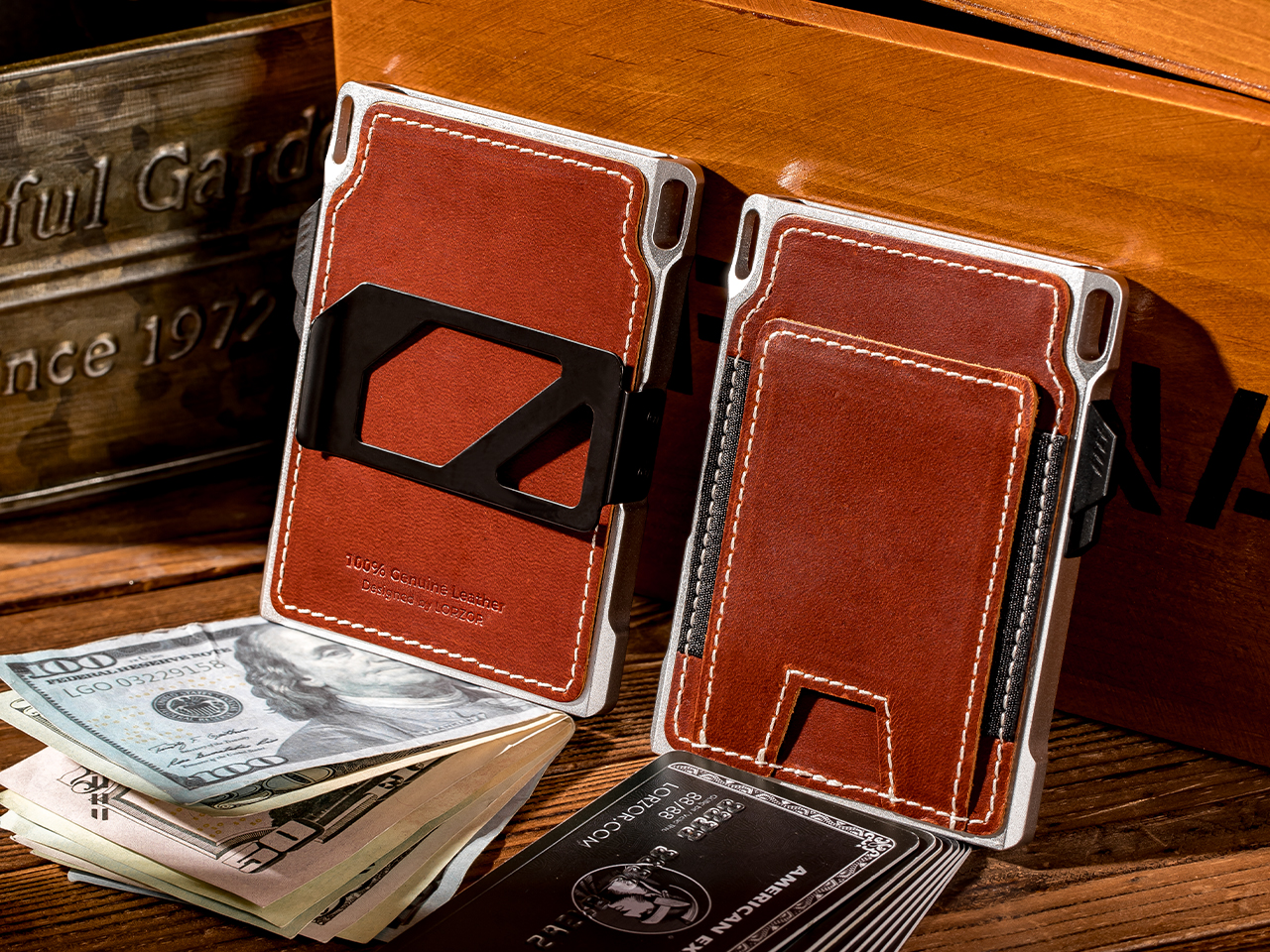
Daily wallet: LORZOR Bifold AirTag Wallet A1, A2 and A4
The daily wallet is the one that leaves the bag. In the LORZOR Bifold AirTag family, all three variants are built on full-grain leather with RFID protection and a built-in AirTag holder, and the differences are about cash handling:
- LORZOR Bifold AirTag Wallet A1 ($29.99–$39.99): a classic bifold structure. The AirTag holder sits inside the expected wallet silhouette rather than being bolted on, which keeps the object looking like a wallet.
- LORZOR Bifold AirTag Wallet A2 ($29.99): adds a money clip to the same feature set, for travelers who still carry folded bills.
- LORZOR Bifold AirTag Wallet A4 ($29.99–$39.99): built-in AirTag holder, RFID protection, full-grain leather and money clip, positioned as a bifold that carries cash cleanly.
For a cross-border trip, the practical benefit is narrow but real: the document wallet never has to be opened for a coffee or a taxi, so the passport never leaves its compartment in the middle of a street. Review feedback on the A4 notes the leather build and the AirTag slot as strengths, and flags that the fastener on the AirTag holder needs to be used with a little care.
Daily wallet alternative: LORZOR TriPop AirTag Wallet
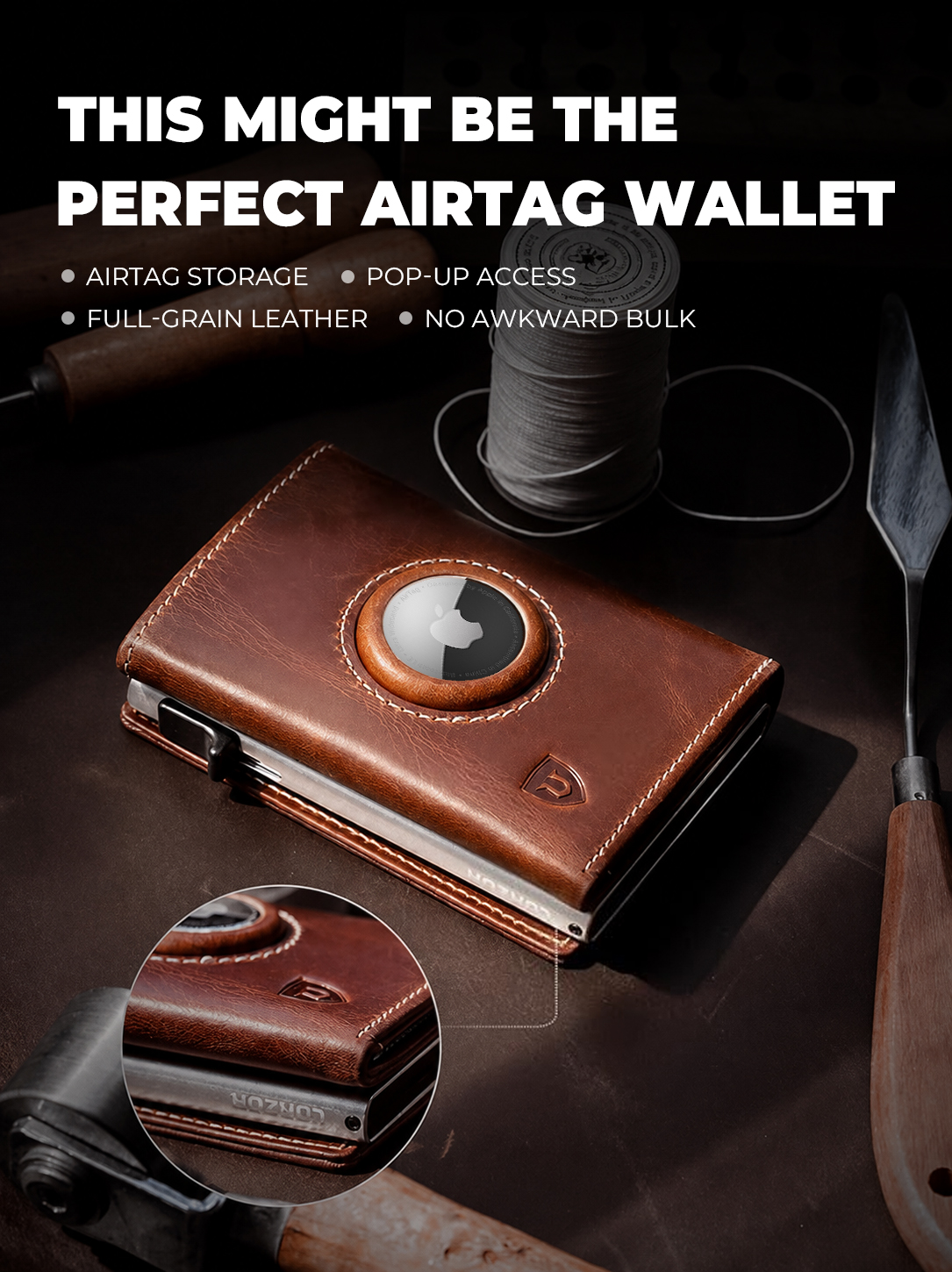
If the daily wallet needs to absorb more cards, the LORZOR TriPop AirTag Wallet ($49.99) is a trifold design with pop-up card access, full-grain leather, RFID protection and a built-in AirTag holder, measuring approximately 0.79 × 2.64 × 3.86 in. AirTag is not included.
Its most relevant engineering detail for travelers is that the AirTag slot was designed around the physical thickness of an AirTag, so the tracker does not turn a leather wallet into an obvious bump. The non-AirTag LORZOR TriPop Wallet ($49.99) provides the same leather trifold format with pop-up access, an ID window and a cash compartment, and holds roughly 8–12 cards. Where the TriPop AirTag version adds tracking, the TriPop Wallet adds organization for people who do not need a tracker in the wallet that goes to the counter.
Slim front-pocket option: LORZOR Wallet Pro or LORZOR 1979 SP Wallet
Some travelers want the daily element to be as small as possible, especially on meeting days when the document wallet stays in a jacket or bag.
The LORZOR Wallet Pro ($129) is the model where tracking is integrated into the metal cardholder itself: it supports Apple Find My, holds Apple-Certified credentials, measures approximately 2.6 × 0.43 × 3.9 in, and suits 1–6 everyday cards plus a small amount of cash. No separate AirTag is required, and there is no tracker bulge to accommodate because the tracking hardware is built into the structure. For a business trip this is the wallet that handles counter payments while the passport stays where it should.
The LORZOR 1979 SP Wallet ($129.99) is the limited-edition route into the same slim 1979 platform: an America's 250th Anniversary theme with a 1776–2026 commemorative design, limited to 300 sets, ultra-slim, with pop-up card access, full-grain leather, a 6061 aerospace-grade aluminum frame and RFID protection. It does not carry built-in electronics; the 1979 platform supports tracker-card and AirTag-holder attachment setups rather than an integrated module. Buyers who want one wallet to do more of both jobs can also look at the LORZOR 1979 Fold Wallet ($129.99), which holds up to 12+ cards with a built-in ID window and a removable cash clip — but choosing that path means giving up the two-wallet split.
What built-in tracking actually does when the wallet slides under a car seat
A wallet with a built-in AirTag holder is not a GPS device, and it is worth being precise about this because the car-seat scenario is one of the most common real-world loss moments on a road leg.
What you get is Find My network behavior. While the wallet is still within Bluetooth range of your phone, you can trigger an audible chime on the tracker and use the app's proximity view to narrow the search to a small area. That is usually enough to solve the specific problem that stops a trip: the wallet has slipped into the footwell, between the seat rails, into the gap behind the seat, or under the seat frame, and the choice is between searching one vehicle zone and dismantling the car. Sound plus proximity converts that into a targeted search.
Once the wallet is out of range, the view changes to the last location where the tracker was seen by nearby Apple devices, with a timestamp. That is a different kind of information: it answers “where was it last near someone”, not “where is it now”. The same distinction applies to the Wallet Pro's integrated tracking, with one structural difference — there is no separate AirTag and no holder to check, because the module sits inside the metal cardholder.
The realistic expectation for the car-seat case is therefore: fast local recovery while you are still near the vehicle, and a location-plus-time clue if you have already driven away.
How quickly tracking helps after a loss at a hotel or an airport
These are two different problems wearing the same name, and the two-wallet split changes which one you are solving.
Hotel or rental car: the item is usually still inside a building or a vehicle, which means range-based tools are still available. Checking Find My, sounding the chime and walking the room or the car interior takes minutes, and the useful window is before checkout or before the vehicle is returned. This is the scenario where the split pays off twice: if the daily wallet is missing, the passport is almost certainly still in the document wallet, so the urgent problem does not include a document emergency.
Airport: the wallet may already be out of range when you notice. Here the useful output is not live direction but an evidence trail — a last-seen location and time that you can show to an airport lost-and-found desk, an airline service counter, a hotel front desk or a rental agency, rather than describing the wallet from memory. It also tells you whether the wallet stayed in the terminal, moved with a cleaning cart, or traveled to a place you never visited.
Neither mechanism guarantees recovery. What the tracker does is shorten the search and improve the description. That is also why placement of the tracker is itself a decision: for many business travelers the document wallet is the one worth tracking first, because a missing passport costs more of the trip than a missing card wallet. The Passport AirTag Wallet puts the holder in the passport sleeve for exactly that reason.
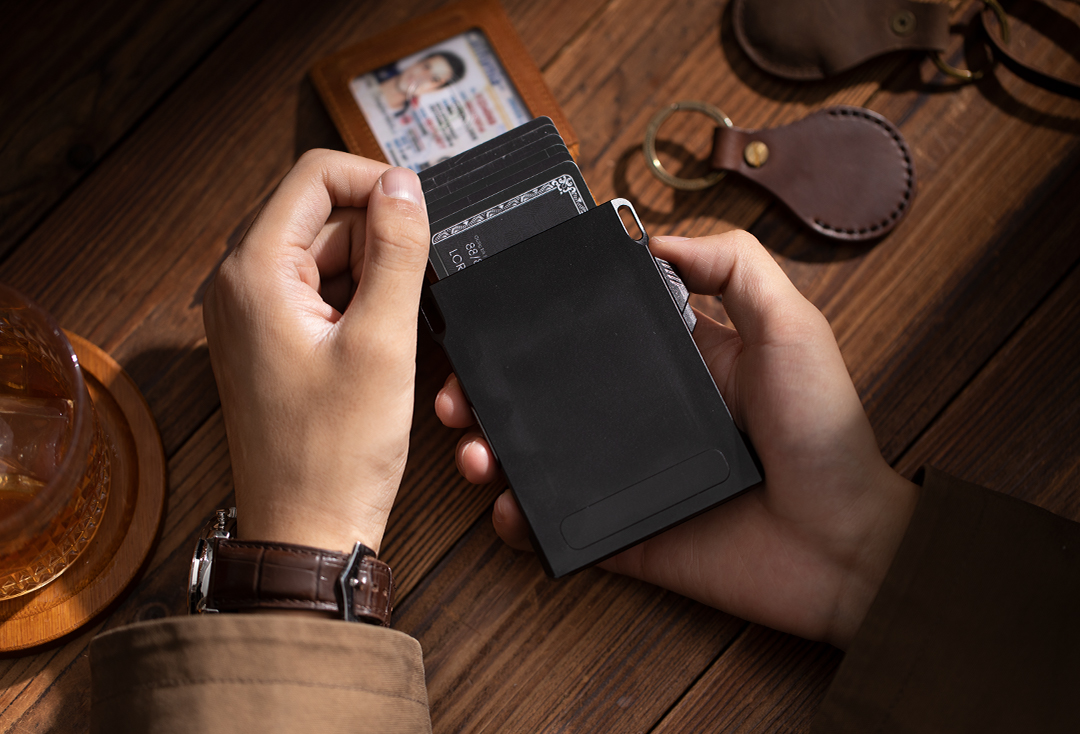
RFID: what the tested shielding covers, and what it does not
Both the LORZOR Passport Wallet and the LORZOR Passport AirTag Wallet include RFID protection, and the shielding is tested rather than merely claimed. LORZOR's RFID shielding tests run at 13.56 MHz using credit cards and professional RFID test signal cards, and signals cannot be read when cards are correctly placed inside the protected zone. The brand holds test certifications including TÜV and AGC, along with test photos and video assets.
Three boundaries matter for travel use, and stating them makes the protection more useful, not less:
- Placement decides coverage. A contactless card sitting in an outer quick-access slot is not the same as a card inside the protected zone. Quick-access slots are for cards you tap constantly; the protected zone is for cards that should stay quiet.
- The documented scope is a frequency, not a promise about everything. Shielding is tested at 13.56 MHz contactless cards. Do not read that as a blanket protection statement covering every document, chip or frequency you might carry.
- It replaces nothing else. RFID protection sits alongside transaction alerts, card controls and the habit of not leaving the document wallet on a hotel desk.
Step-by-Step Breakdown: Setting Up a Two-Wallet Cross-Border Carry
Step 1 — Assign roles before you pack
Document wallet: passport, tickets, hotel key, receipts, coins, SD card. Daily wallet: the cards you actually tap, plus the day's cash. Front-pocket wallet: two or three cards for counters. Any item that does not have a role belongs in neither wallet.
Step 2 — Insert and name the tracker before you fly
The Passport AirTag Wallet takes an AirTag in its built-in holder, compatible with AirTag 1st and 2nd generation; the AirTag is not included. Insert it early enough to name it by function rather than by object — “Passport” rather than “black wallet” — and test the chime once. Wallet Pro users skip this step entirely, because tracking is built into the cardholder and supports Apple Find My directly.
Step 3 — Load by frequency of use, not by category
Cards you use at counters go in the pop-up cartridge or the front slots. Cards that should stay put go in the protected zone. Documents go in the passport compartment and stay there between uses — a passport pulled out “just to check” is a passport that ends up on a hotel desk.
Step 4 — Separate the two wallets physically
The whole benefit comes from the document wallet not living in the same pocket as the daily wallet. Jacket inner pocket or bag front compartment for documents; front pocket for the daily wallet. The habit that fails is not the wallet, it is putting the document wallet down for two minutes at a counter and walking away.
Step 5 — Run one dry run before departure
Load the document wallet as you would on the trip, close it, leave it in another room, and find it by sound. Also test the load in the pocket you actually use on a travel day, because a wallet that closes fine on a desk behaves differently when it has to fold into a jacket pocket with a passport and cash inside.
Step 6 — Agree on a loss protocol
If the daily wallet disappears: retrace the last two places you paid, then use Find My. If the document wallet disappears: check Find My, capture the last-seen location and time, and go to the hotel desk, airport lost-and-found or rental agency before you leave the country — the trail is most useful while you are still physically in the same place.
Use Cases: Where the Two-Wallet Split Pays Off
| Trip leg | Wallet doing the work | Why it fits |
|---|---|---|
| Airport transit and security | LORZOR Passport AirTag Wallet | Passport, tickets and cards stay in one closed unit; 4 card slots and 10 compartments keep the document cluster together instead of spread across pockets and trays. |
| Boarding area, taxi, coffee counter | Bifold AirTag Wallet A1/A2/A4 or TriPop AirTag Wallet | Only the day's cards and cash leave the bag, so the document wallet is not opened in public. |
| Hotel check-in and check-out | LORZOR Passport AirTag Wallet | Passport, card, key and receipt are the exact cluster that gets scattered on a hotel desk; 10 compartments give each item a place to go back to. |
| Rental car and road legs | Daily wallet with money clip (A2 or A4) | Driving licence and day-cash stay separate from the document wallet, which stays in the bag rather than under the seat — the origin of the car-seat search problem. |
| Client meeting or conference day | LORZOR Wallet Pro or LORZOR 1979 SP Wallet | 1–6 cards in a slim front-pocket format measuring about 2.6 × 0.43 × 3.9 in for the Wallet Pro; no document load to carry into a meeting room. |
| Multi-currency cash days | Bifold A2/A4 money clip plus document wallet reserve | Day-cash sits in the money clip instead of wedging the card stack; the 1979 platform uses a dedicated removable money clip that holds 10+ folded bills without stuffing the card section. |
Comparison Table: Choosing Your LORZOR Cross-Border Configuration
All figures below are published product facts for the LORZOR models named. Where a specification is not published for a model, the table does not state one.
| Model | Price (USD) | Tracking | Role in a cross-border trip | Key published facts |
|---|---|---|---|---|
| LORZOR Passport AirTag Wallet | $49.99 | Built-in AirTag holder; AirTag not included; compatible with AirTag 1st/2nd Gen | Document wallet | All-in-one travel storage; 4 card slots; 10 compartments for passport, cards, cash, coins, SD card; approx. 5.5 × 3.9 × 0.4 in; RFID protection; full-grain leather |
| LORZOR Passport Wallet | $49.99 | None (non-AirTag version) | Document wallet without tracking | 0.4 in thickness; RFID protection; holds passports, flight tickets, cards, cash, receipts and travel documents; full-grain leather |
| LORZOR Bifold AirTag Wallet A1 | $29.99–$39.99 | Built-in AirTag holder; AirTag not included | Daily card wallet | Classic bifold structure; RFID protection; full-grain leather |
| LORZOR Bifold AirTag Wallet A2 | $29.99 | Built-in AirTag holder; AirTag not included | Daily wallet with cash | Adds a money clip to the bifold AirTag feature set; RFID protection; full-grain leather |
| LORZOR Bifold AirTag Wallet A4 | $29.99–$39.99 | Built-in AirTag holder; AirTag not included | Daily wallet with cash | Money clip; RFID protection; full-grain leather; review feedback flags careful use of the AirTag fastener |
| LORZOR TriPop AirTag Wallet | $49.99 | Built-in AirTag holder; AirTag not included | Daily wallet for travelers carrying many cards | Trifold slim design; pop-up card access; approx. 0.79 × 2.64 × 3.86 in; RFID protection; full-grain leather; slot designed around AirTag thickness |
| LORZOR TriPop Wallet | $49.99 | None (non-AirTag version) | Daily wallet without tracking | Holds roughly 8–12 cards; ID window; cash compartment; pop-up card access; RFID protection; full-grain leather |
| LORZOR Wallet Pro | $129 | Tracking built into the metal cardholder; Apple Find My; Apple Certified; no separate AirTag required | Slim front-pocket wallet | Approx. 2.6 × 0.43 × 3.9 in; 1–6 everyday cards plus small cash; pop-up card access; ultra-slim |
| LORZOR 1979 SP Wallet | $129.99 | No built-in tracker; 1979 platform supports tracker-card and AirTag-holder attachment setups | Slim front-pocket option, limited edition | America's 250th Anniversary theme, 1776–2026; limited to 300 sets; ultra-slim; pop-up card access; 6061 aerospace-grade aluminum; RFID protection; full-grain leather |
FAQ: Cross-Border Travel Carry with LORZOR AirTag Wallets
Does the RFID protection in LORZOR wallets actually shield my cards, and is there test documentation?
Both the LORZOR Passport Wallet and the LORZOR Passport AirTag Wallet include RFID protection, and the shielding is tested rather than only asserted. LORZOR's RFID shielding tests run at 13.56 MHz using credit cards and professional RFID test signal cards, and signals cannot be read when cards are correctly placed inside the protected zone; the brand holds test certifications including TÜV and AGC. Two limits apply in practice: shielding depends on cards sitting inside the protected zone rather than in an outer quick-access slot, and the documented test scope is 13.56 MHz contactless cards, so the wallet should be treated as one layer of card security rather than a universal shield for every document or frequency you carry.
Do I need to buy an AirTag for the Passport AirTag Wallet, and what happens if the wallet slides under a car seat?
Yes. The LORZOR Passport AirTag Wallet has a built-in AirTag holder but ships without an AirTag (AirTag not included), and it is compatible with AirTag 1st and 2nd generation. The Bifold AirTag Wallet A1, A2 and A4 and the TriPop AirTag Wallet also rely on built-in AirTag holders rather than integrated electronics, while the LORZOR Wallet Pro is the model with tracking built into the metal cardholder, Apple Find My support and no separate AirTag needed. If a tracked wallet slides under a car seat, it behaves as a Find My item rather than a GPS device: while the wallet is still within range you can trigger an audible chime and use the app's proximity view to search the footwell, the seat rails or the gap behind the seat instead of emptying the whole vehicle. Once it is out of range, the view switches to the last location where the tracker was seen by nearby Apple devices, with a timestamp — useful for telling a rental agency where to look, but not a live map.
What does a two-wallet LORZOR travel setup cost?
Prices are published per model. A document wallet costs $49.99 in either version: the LORZOR Passport AirTag Wallet or the non-AirTag LORZOR Passport Wallet. A daily wallet starts at $29.99 for the LORZOR Bifold AirTag Wallet A2 with money clip, with the A1 and A4 at $29.99–$39.99; the LORZOR TriPop AirTag Wallet is $49.99, and the non-AirTag LORZOR TriPop Wallet is also $49.99 with 8–12 card capacity and an ID window. The slim front-pocket options are $129 for the LORZOR Wallet Pro, which needs no AirTag, and $129.99 for the limited-edition LORZOR 1979 SP Wallet. A practical mid-range combination — Passport AirTag Wallet plus Bifold AirTag Wallet A2 — costs less than either premium front-pocket model, and any AirTag-based configuration requires an AirTag you already own or buy separately.
Can I validate capacity, thickness and tracking before a long trip?
Yes, and one rehearsal at home is usually enough. Check the published dimensions first: the Passport AirTag Wallet is approximately 5.5 × 3.9 × 0.4 in with 4 card slots and 10 compartments, and the Wallet Pro is approximately 2.6 × 0.43 × 3.9 in for 1–6 everyday cards plus small cash. Then load the wallet the way you would on the road and put it in the pocket you actually use, because full-load thickness differs from empty thickness. Finally, insert and name the AirTag, close the wallet, and find it by sound from another room — the closest available rehearsal for losing it at a hotel. In the available review data the Passport AirTag Wallet reports a 5.0 rating across 26 reviews, with repeated feedback on leather quality, capacity and durability after multiple trips, and the repeated caveat that the AirTag is not included.
How long does shipping take, and where can I buy the wallets?
The LORZOR Official Store (lorzor.com) ships free on all orders. For items in the US, UK or EU where stock is available, delivery typically takes 3–5 business days; if the item is not available locally, it ships from the international warehouse in about 7–15 business days. Regular courier service is primarily USPS, and US-warehouse products offer an expedited UPS option at $28 USD that typically takes 1–3 business days. Payment methods include Visa, Master, PayPal, Affirm and Klarna. LORZOR also sells through Amazon US and Amazon Germany/EU for buyers who prefer marketplace checkout and review browsing. If you are still deciding between a document wallet, a daily wallet and a front-pocket Wallet Pro, the product pages on lorzor.com list the current specifications for each model.
Conclusion
Cross-border business travel does not need a bigger wallet. It needs one wallet that stays closed and one that does not. The LORZOR Passport AirTag Wallet keeps passports, tickets, cards, cash and receipts in a single 0.4 in document case with 4 card slots, 10 compartments and an embedded AirTag holder, while a Bifold AirTag Wallet or TriPop AirTag Wallet handles the cards and cash that come out fifty times a trip. The Wallet Pro covers the days when only a slim front-pocket cardholder belongs in your pocket, with tracking built into the metal cardholder and no AirTag to add.
The two technical questions that decide whether the setup works are also the two most often answered loosely. Tracking is a Find My behavior, not GPS: it shortens a search inside a hotel room or under a car seat, and it produces a last-seen location and time at an airport. RFID is a tested 13.56 MHz shielding function that depends on correct card placement inside the protected zone, not a universal guarantee. Get those two expectations right, and the rest of the system is simply a matter of assigning each item one place and putting it back.

Build your two-wallet travel carry
Compare the LORZOR Passport AirTag Wallet, the Bifold AirTag Wallet A1/A2/A4, the TriPop AirTag Wallet, the Wallet Pro and the 1979 SP Wallet side by side, then choose the configuration that matches how you actually move. Product specifications, current pricing and shipping details are listed on the LORZOR Official Store. Buyers in the US and Germany/EU can also order through Amazon US and Amazon Germany/EU.
Have Questions or Need More Details?
Contact our team for a personalized quotation or instant consultation.
Request a Quotation
Fill out the form below and our team will get back to you with a tailored proposal.
WhatsApp Direct Chat
Prefer to chat in real-time? Message us on WhatsApp for instant assistance & quick answers.
- Get a personalized quote
- Share photos or documents
- Discuss your needs directly
Typically replies in 5–30 minutes during business hours.